As an Amazon Associate, we earn from qualifying purchases. Some links on this site are affiliate links at no extra cost to you. Our recommendations are based on thorough research and editorial judgment.


Are Wide SUP Boards Better For Stability?

Yes, wide SUP boards are markedly better for stability! We’ve found that boards between 31-34 inches provide exceptional balance, especially for beginners. The extra width distributes weight more evenly across the surface, making it easier to stay upright even in choppy conditions. While wider boards may create more drag and reduce speed slightly, they’re perfect for building confidence on the water. Understanding your specific needs and weight class will help determine the ideal width – there’s more to reflect on when choosing your perfect board.
Key Takeaways
- Wider SUP boards (33″-36″) provide superior stability by distributing weight across a larger surface area, making them ideal for beginners.
- Extra width helps dampen wave impact and resist tipping, creating a more forgiving ride in choppy conditions.
- Board width directly affects balance, with wider boards offering better stability at the cost of speed and maneuverability.
- Heavier paddlers benefit most from wider boards (32-34 inches) as the extra surface area better supports their weight.
- While wider boards enhance stability, they create more drag and can be challenging to control in windy conditions.
Understanding Width’s Role in SUP Balance
When it comes to SUP balance, width is your best friend! Understanding basic stability metrics helps us choose the perfect board for our needs and skill level.
Let’s break down the width impact: Wider boards (33″-36″) provide exceptional stability – perfect for beginners finding their sea legs! Think of it as training wheels for your paddling journey.
Meanwhile, narrower boards (28″-31″) require more skill but reward us with better speed and maneuverability. Want to race or tour long distances? These sleeker options are your go-to choice.
Here’s the simple truth: an inch or two of extra width can dramatically improve your balance without sacrificing performance. Even in choppy conditions, wider boards help us stay confident and upright. Ever tried balancing on a tightrope? A wider board is like giving yourself a nice, comfortable platform instead! Additionally, the paddle length options consider height and water type for optimal paddle choices, which can further enhance stability while paddling.
The Science Behind Wide Board Stability
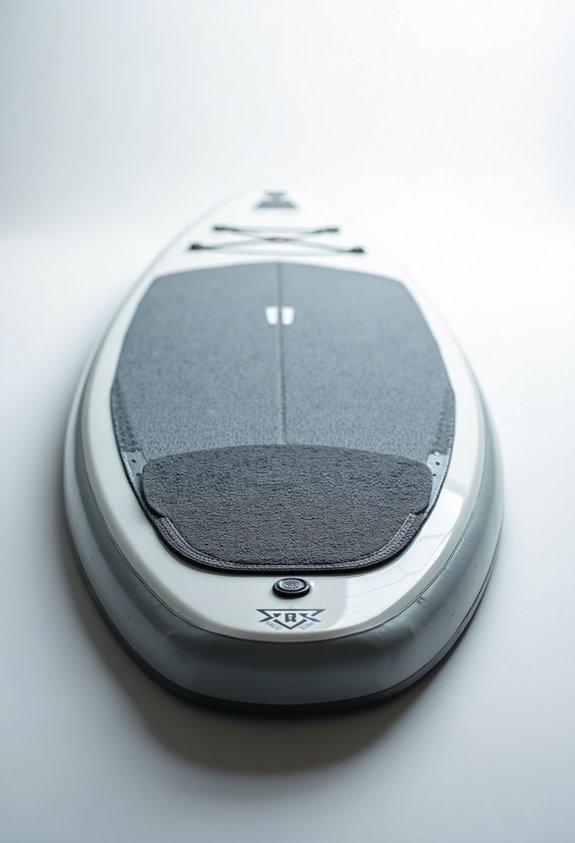
Although the basics of SUP stability might seem mysterious, there’s fascinating science behind why wider boards keep us steady!
The physics is actually quite straightforward: wider boards distribute our weight across more surface area, creating a more stable platform beneath our feet. Like a boat with a broader hull, these boards naturally resist tipping.
What makes this particularly effective is how the increased width complements our center of gravity and paddle technique. When we’re standing on a wider board, we’ve got more room to adjust our stance and maintain balance, especially in choppy conditions.
Think of it like standing on a balance beam – wouldn’t you rather have a wide one than a narrow one? The extra surface area doesn’t just support us; it actively works with the water to dampen waves and provide a more forgiving ride! Furthermore, the measurement accuracy of the board’s inflation is vital for achieving optimal stability and performance on the water.
Comparing Narrow Vs Wide SUP Boards
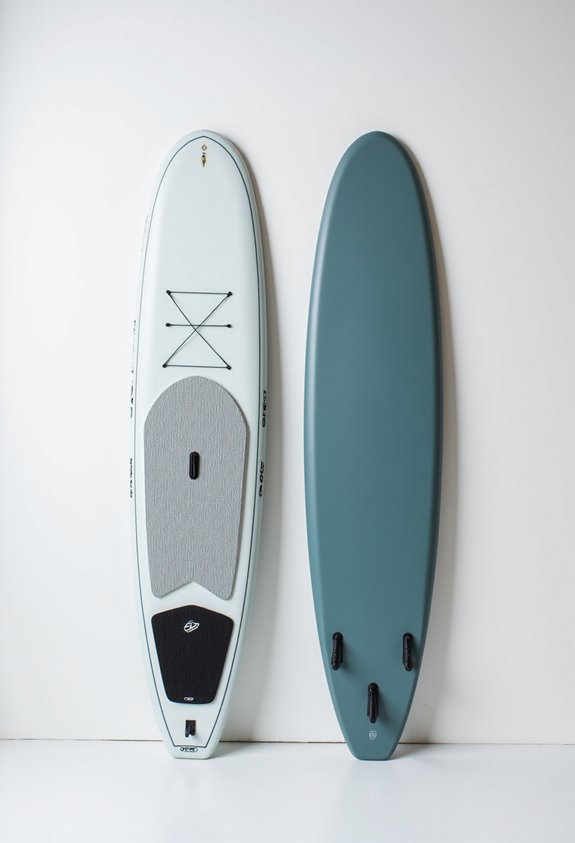
Anyone considering a new SUP board faces an essential choice between narrow and wide designs! Let’s explore how these options compare across key factors that affect your paddling experience.
Narrow boards (under 24″) offer speed and maneuverability but come with stability challenges that demand advanced paddling skills. They’re ideal for racing and skilled paddlers who’ve mastered proper paddling techniques.
Wide boards (over 32″) deliver maximum stability – perfect for beginners, yoga enthusiasts, and challenging weather conditions! Your rider weight plays a significant role in board customization decisions. Additionally, heavy-duty materials such as those used in tactical dry bags enhance overall durability and performance during outdoor pursuits.
We find that most recreational paddlers achieve their sweet spot with boards between 30-32″ wide. These measurements provide an excellent balance of stability and performance, regardless of board materials used. Why struggle with a board that’s too narrow when you can enjoy confidence-building width?
Recommended Products

【3 Year Manufactures Guarantee】-Niphean is committed to providing excellent customer service and reliable product quality. Each Niphean product includes a 30-day return policy and comes with a Manufacturer’s Guarantee that is three times as long as the industry average, offering greater confidence and long-lasting performance. If you experience any issue with your inflatable paddle board, please feel free to contact Niphean.

Reliable and Durable Accessories:Each paddle board comes with high-quality,adjustable paddles,a sturdy leash,a reliable pump and with the necessary sup accessories to get start right away.We’ve paid attention to every detail to ensure that your accessories are as durable and easy to use as the board itself.

𝟑𝟓″ 𝐄𝐱𝐭𝐫𝐚-𝐖𝐢𝐝𝐞 𝐒𝐢𝐳𝐞 𝐟𝐨𝐫 𝐁𝐞𝐭𝐭𝐞𝐫 𝐒𝐭𝐚𝐛𝐢𝐥𝐢𝐭𝐲 With a length of 11', a width of 35", and a thickness of 6", FLYPARK family paddleboard offers a stable platform for outdoor activities. The extra width (3" added to the surface area) enhances buoyancy and minimizes side-to-side wobbling, making it ideal for movements like stand-up paddling, yoga or lounging with family.
Best Width Options for Beginners
The best width for beginner SUP boards centers on maximizing stability while maintaining manageability! When evaluating board dimensions, we recommend focusing on the sweet spot between 30-34 inches wide.
For most newcomers, here’s what we’ve found works best:
- Lightweight paddlers (under 125 lbs): 31-32 inches
- Average weight (125-175 lbs): 31-33 inches
- Heavier paddlers (175+ lbs): 32-34 inches
These stability factors aren’t just random numbers – they’re proven to help you stay confident on the water! Think of it like finding the perfect pair of shoes – too narrow and you’ll wobble, too wide and you’ll struggle to move efficiently. Wider designs (33-35 inches) provide enhanced stability and safety, making them ideal for beginners.
Want extra stability for activities like SUP yoga? Go with 32+ inches. Planning to catch some waves? Stick closer to 31-32 inches for better maneuverability!
Recommended Products

【Brand Philosophy】FEATH-R-LITE paddleboards are built on the principles of simplicity and minimalism, and we are committed to creating minimalist yet stylish gear that resonates with sports enthusiasts who appreciate an active lifestyle.
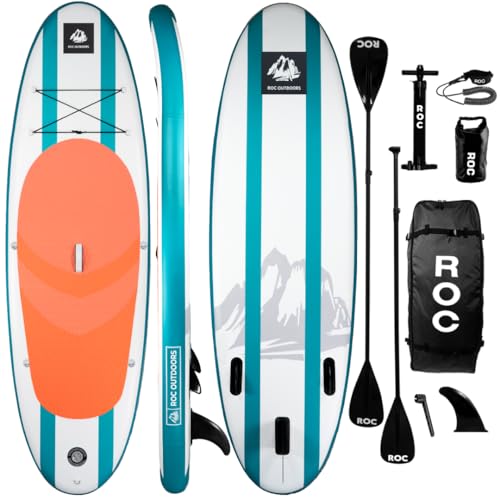

【User Scenarios】FEATH-R-LITE paddle boards is your first choice for water sports.Funwater inflatable paddle boards (SUP) are suitable for all skill Levels to enjoy themselves, explore, or adventure in water areas.
Weight Capacity and Board Width Relations
Understanding how board width affects weight capacity is essential for finding your perfect SUP match! Width plays a significant role in how much weight your board can handle, with just a 1-2 inch increase nearly doubling the carrying capacity in similar shapes.
We’ve found that wider boards (31-34 inches) excel at weight distribution, keeping you higher above the water for better paddle efficiency. Think of it like standing on a floating platform – the wider it is, the more stable you’ll feel!
Here’s what happens with proper width-to-weight matching:
- Better stability and less wobble
- Improved buoyancy under heavier loads
- More even weight distribution
- Reduced risk of excessive sinking
Remember to factor in your gear weight too! A board that’s too narrow for your weight won’t just feel unstable – it’ll make paddling much harder than necessary. Additionally, choosing the right paddle length that suits your height can further enhance your overall paddling efficiency.
Performance Trade-offs of Wider Boards
While wider SUP boards offer incredible stability for beginners and families, they come with some notable performance trade-offs that you’ll want to contemplate!
Let’s look at the stability metrics: wider boards excel at keeping you steady, but they’ll slow you down due to increased drag and resistance in the water. Think of it as driving a large SUV versus a sports car – you get comfort and security, but sacrifice speed and agility!
Performance efficiency takes a hit in windy conditions too. Those wide boards act like sails, making it harder to maintain your course. And while they’re incredibly stable for activities like yoga or fishing, you’ll find them less nimble when trying to make quick turns. It’s also worth noting that the comfort-focused features in life vests can enhance your overall experience while paddling.
The good news? Most paddlers gladly accept these trade-offs for the confidence-building stability they provide!
Choosing the Right Width for Your Style
Selecting your ideal SUP board width doesn’t have to feel overwhelming! Let’s match your needs to the perfect board width based on your riding style and goals.
For beginners focusing on basic balance techniques and a stable paddling stance, we recommend starting with a 32-34 inch width. This extra stability will help you build confidence on the water!
Ready to progress? Consider these key factors:
- Under 125 lbs? A 29-32 inch board offers plenty of stability.
- Over 200 lbs? Stick with 32-34 inches for excellent support.
- Racing aspirations? Start at 26-28 inches before advancing to narrower widths.
- Love choppy conditions? Wider is better for rough water.
Remember – you can always size down as your skills improve. The perfect width balances your current abilities with your paddling ambitions! Additionally, choosing wider boards (around 33 inches) can significantly enhance stability for beginners while providing a solid platform for safety.
Width Considerations for SUP Yoga
Now that you’re comfortable choosing a board width for general paddling, let’s explore the unique demands of SUP yoga!
When it comes to yoga poses on water, stability is everything. We strongly recommend wider boards in the 33-36″ range for maximum steadiness during those tricky shifts and balance poses.
Here’s why width matters so much for SUP yoga:
- A broader platform means less wobbling during Warrior pose
- More surface area helps prevent unexpected dips while flowing between movements
- Wider decks accommodate taller practitioners’ full leg spans
Think about it – nobody wants to face-plant during their peaceful morning meditation! While advanced yogis might handle narrower boards, we typically suggest 32″+ width for beginners and intermediate practitioners. Remember, a stable foundation lets you focus on your practice rather than fighting to stay dry! Additionally, wider boards often provide enhanced stability for various water conditions, making them suitable for all skill levels.
Recommended Products

【AISUNSS Meditation Paddle Board】- 10.6ft length x 33'' width x 6'' Height and weight capacity up to 450lbs. The extra widely SUP Board design is easy for beginners to stand up and keep balance. It's an ideal board for all skill levels for enthusiasts of different ages.

【Unique Design】the pattern on the paddle board is based on the background of the ancient guardian god, which is a symbol of goodness and hope. the FunWater brand will also support the aspirations and pursuits of the sportsmen to transcend themselves, and guard the sportsmen's love for water sports.

WIDE AND LIGHTWEIGHT SUP DESIGN - Three sizes stand up paddling board, 11' long and 33''of deck width for improved stability and balance while standing.Paddle Boards Premium Paddle Board is Made Of The Highest Quality Military Grade Material. Providing The Most Durable Lightweight Board On The Market.
Speed and Maneuverability Factors
As you’re considering speed versus stability in SUP boards, understanding the relationship between width and performance becomes essential! Let’s explore how width affects your speed dynamics and maneuverability challenges.
Wide boards create more drag in the water, which means you’ll paddle harder to maintain speed. Think of it like pushing a barn door through water versus a knife blade!
We’ve found that narrow boards offer these key advantages:
- Faster speed potential with less water resistance
- Quicker turning and improved maneuverability
- More efficient vertical paddle strokes
- Better performance in windy conditions
But here’s the trade-off – while narrow boards excel in speed and agility, they demand more skill to handle. That’s why we often see racers on super-narrow boards, while beginners benefit from wider, more stable options. Additionally, sustainable materials like bamboo paddles can enhance your overall paddling experience, providing lightweight durability.
Optimal Board Width for Different Activities
The right board width can make or break your SUP experience! Let’s explore the ideal widths for different paddling activities to help you find your perfect match.
For all-around paddling and touring, we recommend boards between 31-34 inches wide. This sweet spot allows for comfortable paddle technique while maintaining rider comfort for long days on the water.
Want to catch some waves? Surf-specific SUPs run narrower at 28-30 inches to help you carve those turns!
Looking to perfect your downward dog on water? Go wide! Yoga enthusiasts should opt for boards 33 inches or wider for a stable floating platform.
Racing enthusiasts have different needs:
- Beginners: 26-28 inches
- Intermediate: 23-24 inches
- Advanced: As narrow as 21 inches (if you’re ready for the challenge!)
Additionally, boards with wide decks enhance overall stability, making them particularly beneficial for beginners and various activities like yoga.
Recommended Products
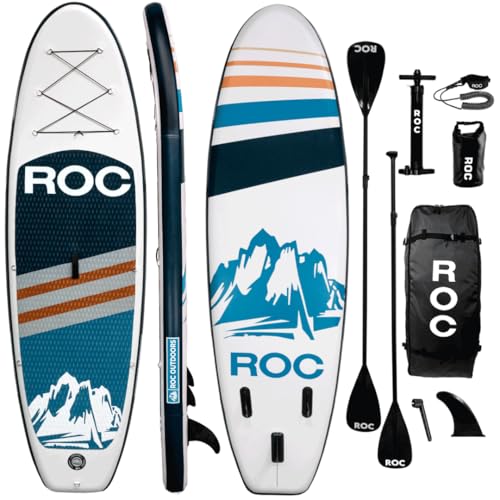
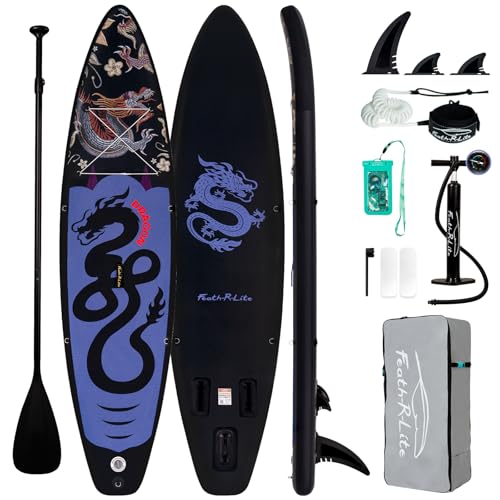
【Flying Dragon Pattern】This must be the most unique pattern and will surely make you a unique scenery on the water. We chose the mythical and dominating dragon as the paddle board pattern. The flying and hovering dragon has great energy and explosive power, and can fly freely on the sky. This is what water sportsmen who love adventure and exploration are looking for, the freedom to soar between the water waves.
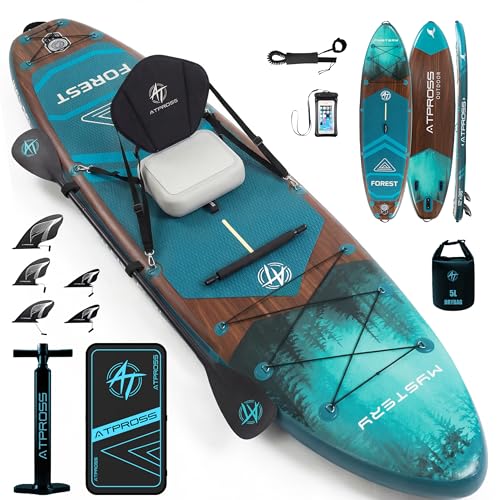
【12'X36" SUPER WIDE & ULTRA STABLE – BEGINNERS & FAMILIES FRIENDLY】 Designed with a 36" extra-wide platform (4" wider than standard 32" boards), this paddleboard offers unmatched stability for beginners, families, and yoga enthusiasts. The spacious deck easily fits, pets, or extra gear without tipping, making it perfect for relaxed cruising, water workouts, or bonding time on the lake.
Wind Resistance and Wide Board Handling
While wider SUP boards offer excellent stability, they’ve got a fascinating relationship with wind that every paddler needs to understand!
Let’s face it – those wide boards catch more wind, which affects board handling in some interesting ways. Think of it like holding up a sail – the larger surface area means more resistance when the breeze kicks up!
Here’s what we’ve learned about managing wide boards in wind:
- Shift your weight slightly forward to keep the nose down
- Bend those knees for better stability
- Drop to kneeling if the wind really picks up
- Use controlled, deliberate paddle strokes
The trade-off? While wide boards may slow us down in windy conditions, they give us fantastic stability that helps maintain control. For many paddlers, that’s a worthwhile exchange – especially when those gusty days come calling!
Expert Tips for Wide Board Selection
Ready to choose your perfect wide SUP board? Let’s plunge into expert recommendations that balance stability with your paddling goals!
For beginners, we recommend starting with a 26-28″ width to build confidence while maintaining maneuverability. User experiences show this range hits the sweet spot for learning.
Consider these key factors:
- Your weight and height (check manufacturer charts!)
- Material durability (quality construction matters more than thickness)
- Primary activities (yoga needs wider, fishing needs stable)
- Skill progression potential
Most paddlers find success with boards in the 31-34″ range, offering that perfect balance of stability and performance. Want to maximize stability? Look for models around 34″ – they’ll handle nearly twice the weight capacity of their 31″ counterparts without sacrificing material durability or ride quality.
Remember: wider isn’t always better, but it’s often more fun for casual paddling!
Recommended Products

【Brand Philosophy】FEATH-R-LITE paddleboards are built on the principles of simplicity and minimalism, and we are committed to creating minimalist yet stylish gear that resonates with sports enthusiasts who appreciate an active lifestyle.

【Paddle Board Size】FunWater paddle boards are designed with 10' 6"length, 33" width and 6" thickness, great balance and stability, ideal for kids, adults, beginners and experienced surfers, you can surf, paddle, yoga and fish on it and have a wonderful experience!
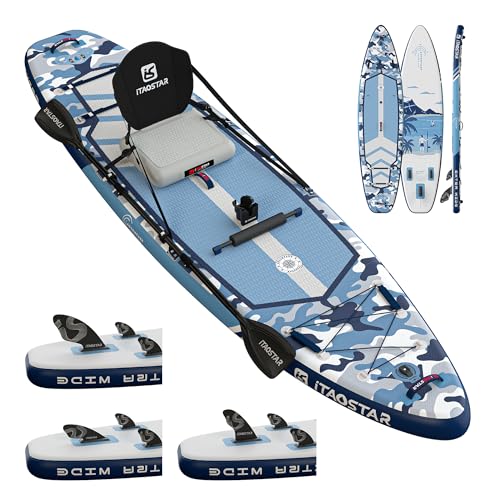
【More Assured】Ride with confidence backed by our 3-year warranty and master the waters quickly with our beginner-friendly guide—your safety and satisfaction always come first
Frequently Asked Questions
Can I Use a Wide SUP Board in Rough Ocean Conditions?
We don’t recommend using any SUP board in rough waters, regardless of width. For ocean safety, it’s best to paddle during calm conditions and always check weather forecasts before heading out.
How Does Board Width Affect the Durability of a SUP?
We’ve found that board width alone doesn’t determine durability. What matters most are the board materials and quality construction. While wider boards can distribute weight better, proper maintenance and material quality are the key factors.
Do Wide SUP Boards Require Different Paddle Length Than Narrow Boards?
No, we don’t need different paddle lengths for wide or narrow boards. Let’s keep it simple – your paddle length depends on your height and paddling technique, not your board width. That’s the whole scoop!
Are Inflatable Wide SUP Boards as Stable as Solid Wide Boards?
While inflatable vs solid wide boards both offer good stability, we’d say solid boards are generally more stable due to their lower center of gravity, rigid construction, and better performance in choppy water conditions.
What Storage Considerations Should I Keep in Mind for Wider SUP Boards?
Like guardians of your prized possession, we’ll help you safeguard wider SUPs. Keep them in climate-controlled spaces, guarantee your storage capacity matches board size, and consider transport options with proper racks and protective covers.


